The Perfect Racing Line Is a Useful Myth
The perfect racing line is a useful comparison, not a fixed rule. Learn how corner shape, car balance, traffic and race priorities change the fastest path.
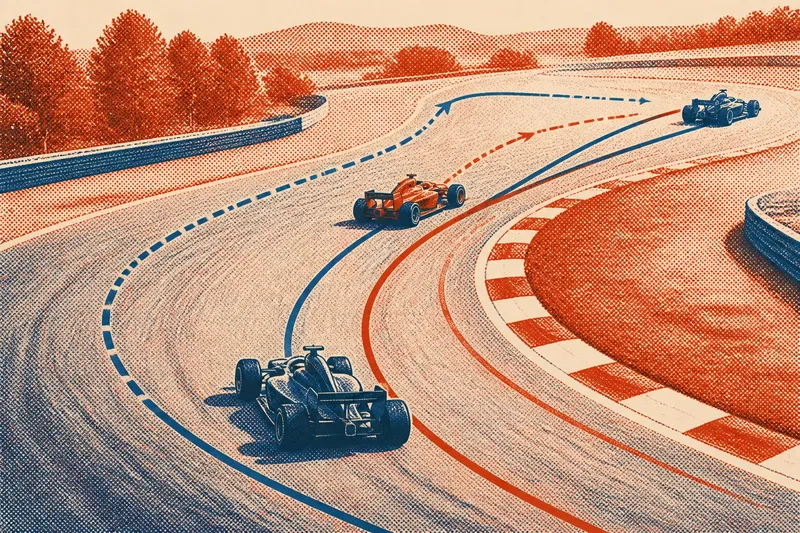
The most common mistake with the perfect racing line is treating it as a painted route every car should copy. That mistake costs drivers options: a line that suits one corner, car or lap condition can leave another driver exposed or out of position. The perfect racing line is more useful as a comparison—a reference for judging what a particular turn asks of the car.
1. Start with a reference
A familiar racing line gives drivers a shared way to describe a corner: approach wide, turn toward the inside, then use the available track on exit. On a clear lap, that path often helps reduce unnecessary steering and preserve speed. It is a starting point, not a command.
The comparison becomes useful when you ask what changed. Is the apex later than expected? Did the car run wide? Did the driver need to lift earlier? Those observations point to a specific adjustment, while “drive the perfect line” offers no explanation by itself.
Use the conventional line to frame a question, then look for the answer in the corner and the car.
2. Read the corner shape
Two turns with similar widths can reward different paths. A tight hairpin usually asks a driver to slow substantially and turn around a small radius. A long, flowing bend may reward a smoother arc and an earlier commitment. A corner that opens on exit can make a later apex attractive; one that tightens may punish a driver who assumes the radius will stay constant.
Track limits and the next section matter too. If the outside edge is narrow, a driver may choose not to use every inch on exit. If a short straight follows, getting the car pointed toward it can matter more than carrying speed deep into the current turn. The visible corner is only part of the route decision.
Judge the line by the whole sequence, not by the shape of one bend.
3. Account for the car
A line is only fast if the car can follow it with control. A car that resists turning may need a different entry or a more patient rotation than one that responds readily. Tire condition, braking behavior, aero balance and power delivery all influence when a driver can ask for steering, braking and throttle.
That does not mean each car needs a wholly separate map of the circuit. It means the familiar reference line should be checked against how the car behaves. If the front tires slide when the driver aims at a conventional apex, forcing the same path may increase the slide rather than produce a better turn. A driver may adjust the approach, reduce the demand, or prioritize a cleaner exit.
Imagine a driver in a car that struggles to rotate into a tight corner. If the driver turns in later and brakes in a more controlled way, the expected observable result is a car that reaches the apex with less front-end push, even if it gives up a little entry speed.
4. Separate lap goals
The best line for a clear qualifying lap may not be the best line for a race. On a clear track, a driver can focus on carrying speed through the corner. In traffic, another car may occupy the usual entry or apex, so a different path becomes necessary. That alternate route may be slower through the turn but keep the driver close enough to attack on the next section.
Defending changes the decision again. A driver may position the car to protect the inside, accepting a compromised path through the corner. The priority is then to make the rival take a longer route or delay their exit, while still leaving room and keeping control. The racing line is a tactical choice, not just a speed trace.
Ask what the driver needs after the corner: clean air, a pass, a defense, or a stable exit.
5. Compare, then adapt
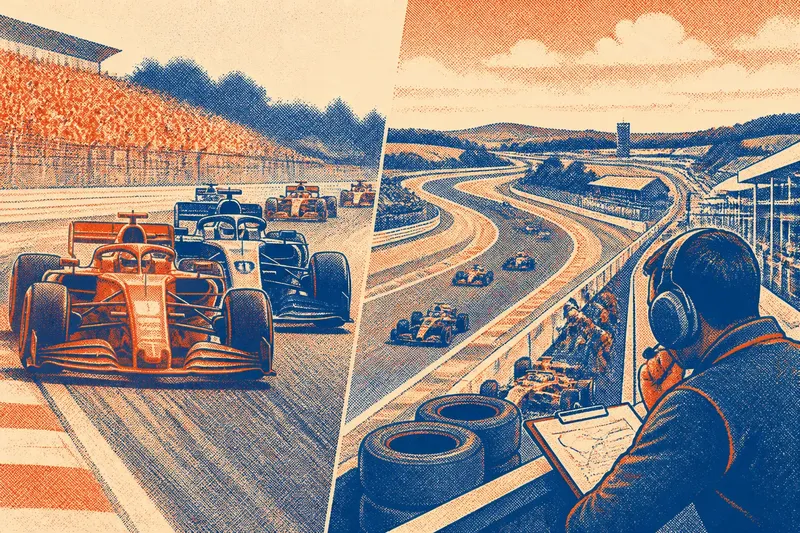
Watching two cars take the same corner can reveal why “the line” is an incomplete idea. One driver may brake earlier and turn in smoothly; another may brake later and use a sharper rotation. Their paths can differ because of car balance, tire condition, traffic, or the corner that follows. A visible difference does not automatically mean one driver has made an error.
For a useful comparison, track a few observable points: where braking begins, how the car approaches turn-in, whether it reaches the apex, how much steering correction appears, and how cleanly it accelerates away. Compare like with like when possible: similar traffic, similar conditions and the same race objective. Then ask which choice solved the driver's actual problem.
This turns the ideal line into a tool for interpretation. Instead of asking whether a driver followed it, ask what the driver gained or risked by departing from it.
Questions about racing lines?
Is the racing line always the fastest route?
It can be a useful reference for a clear lap, but the fastest choice depends on the corner, the car and the goal. Traffic or a defensive position can make another path more useful.
Why do drivers use different apexes?
A later apex can help a driver point the car toward a straight or manage a corner that tightens. An earlier one may suit a different shape or sequence, but it can leave less room to accelerate on exit.
Can a driver pass off the racing line?
Yes, if there is space and the driver can make the move safely and within the rules. The alternative path may sacrifice corner speed in exchange for position or a better setup for the next turn.
How should a beginner learn a circuit line?
Use a clear reference from a track map or qualified instruction, then learn how the car responds at a controlled pace. Build consistency before changing the path, and follow the circuit’s rules and the car’s operating guidance.
Keep the comparison useful
The perfect racing line remains valuable because it gives drivers and spectators a common reference. It becomes misleading only when treated as a universal answer. For any corner, compare the familiar route with the car’s behavior, the space available, the next section and the immediate race objective.
When a driver leaves the expected path, look for the reason before judging the choice. That habit makes the racing line easier to understand—and makes each departure from it part of the racecraft rather than a simple mistake.