Watching a Pit Stop Without Losing the Race
Follow a racing pit stop from the car’s arrival to its return, then connect the stop to rivals, track position and the race story unfolding around it.
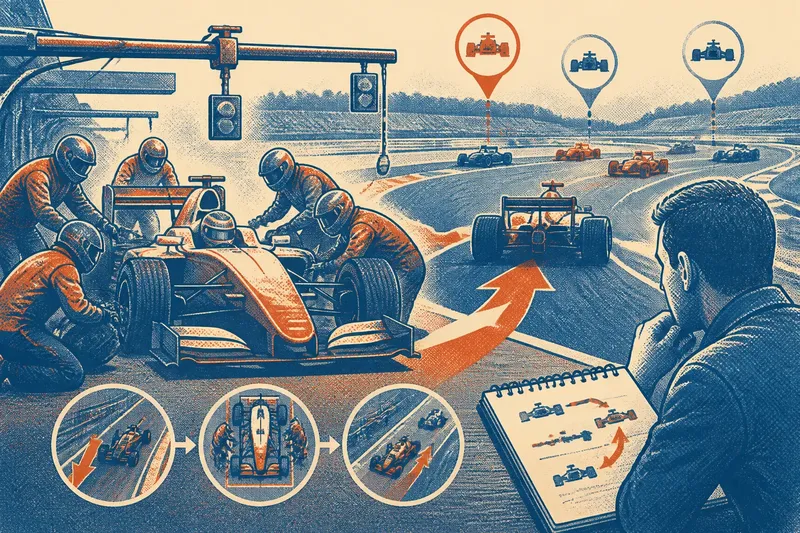
The most common mistake when watching a pit stop is to stare only at the stopped car. That can make a rapid, dramatic moment feel like a pause—and leave you unsure whether the driver gained ground or lost it. A racing pit stop is easier to read as a change in the race’s running order, with the car’s service as one part of that change.
Track the whole sequence
Start before the car reaches the pit lane. Notice its position on track, the gap to the cars ahead and behind, and whether those rivals have already stopped. Then follow three moments: the car leaves the racing surface, it returns, and its position becomes clear once the surrounding traffic settles.
The stop itself is only the middle of that sequence. A car may appear to lose places while stationary but return to open track, while a rival that stays out may have to contend with traffic later. The order at the instant of rejoining is a snapshot, not always the race’s settled picture.
Keep your attention on one car, but scan for the nearest rival before and after the stop. That small habit makes it easier to see whether the stop changed a direct contest or simply moved the car into a different stretch of traffic.
Read the pit lane
A pit stop usually combines a visit to the pit lane with some form of service, but the details depend on the racing series and the event. A stop may involve changing tires, taking on fuel where permitted, or addressing a problem. Some formats require a stop; others leave teams to choose whether and when it makes sense.
Watch for the visible sequence rather than trying to interpret every movement around the car. The car slows from the circuit, reaches its assigned area, pauses for the permitted work, and rejoins. If the broadcast cuts away, listen for the announcer’s explanation and use the next timing graphic to recover the car’s position.
The pit lane also has its own traffic. A car can be ready to leave yet have to wait for a clear path, and the exit may place it close to a rival. A stop that looks clean in isolation can therefore lead directly into a contested merge or a queue of cars.
Follow the car’s exit as carefully as its arrival.
Separate elapsed time from position
Position tells you who is currently ahead; elapsed time tells you how far apart cars are. Both matter. A driver may lose a place during a stop but remain close enough to challenge the rival later. Another may keep the same place while falling farther behind a group.
Timing screens often show a running order, gaps, and whether a car has stopped. Learn the labels used by the broadcast, since displays vary by series. If the information is hard to read, treat it as a clue rather than a verdict and check again after the cars have completed another lap.
Imagine a driver running just behind a rival, then stopping while that rival continues. The driver returns behind several cars, but those cars are already close together. The visible result is a lower position; the useful question is whether the driver can clear that traffic and reach the original rival before the rival makes a stop of its own.
That distinction keeps a single timing graphic from becoming the whole story.
Connect stops to strategy
A pit stop changes what a team can do next. Tire choice, the condition of the car, the remaining race distance, and the behavior of competitors can all shape the plan. A stop may be intended to protect position, create a chance to attack, respond to a rival, or deal with a developing issue. Viewers rarely see every piece of information behind the call, so focus on what the choice does to the race.
Compare the stopping car with rivals on track. Are they on similar tires or at different points in their stint? Is the driver returning into clear space, or into a pack that could cost time? Does a rival stop soon afterward, or continue for several laps? These clues reveal whether the first stop created an advantage, a risk, or simply a different sequence of events.
Be cautious about calling a stop successful immediately. A driver who rejoins ahead may still face a rival with fresher tires; a driver who rejoins behind may have a stronger opportunity later. The race needs time to show how those choices interact.
What should you watch next?
What is an undercut?
An undercut is an attempt to gain an advantage by stopping before a rival, then using the changed tire condition or clear track to make progress before the rival stops. Watch the gaps and the cars’ pace after the first stop, then see where the rival rejoins.
What is an overcut?
An overcut is an attempt to benefit by staying on track while a rival stops. The driver remaining out may gain through clean air or by maintaining pace, but traffic and tire condition can alter the result.
Why can a car lose places after a stop?
It may rejoin behind cars that have not stopped, encounter traffic in the pit lane, or emerge close to rivals on track. Check whether those cars are likely to stop later before treating the order as permanent.
Why does the same stop affect cars differently?
Cars may have different tire condition, track position, or room to run after rejoining. The same timing can help one driver find clear track and leave another caught in a group.
Recover after a missed moment
Broadcasts move quickly, and you may miss the pit entry while watching a battle elsewhere. Rebuild the sequence using three cues: the timing order, the gap to nearby cars, and the commentary about who has stopped. A replay can clarify what happened, but the next few laps often show more clearly what it means.
Say you return from a replay to find a driver several places lower. Check whether the leading cars have stopped, whether the driver has rejoined in traffic, and whether the gap to the original rival has changed. That gives you a practical account of the situation without needing to know every detail of the team’s plan.
Keep one question in mind: who is the driver trying to beat next? It may be the rival behind, the car just ahead, or a competitor who has yet to stop. That target changes as the field cycles through the pits.
Read the result in context
When the cars have completed their stops, look again at the order and the gaps. Ask whether the original pairing has changed, whether the returning car has clean track, and whether a tire or service issue is visible. Then watch the next on-track encounter: that is where a stop’s effect becomes part of the actual contest.
Rules and permitted work vary by series, so use the event’s broadcast explanation when a specific procedure is unclear. For everyday viewing, the most useful habit is simpler: note the car’s position before its stop, follow its return, and compare its new situation with the rival it was chasing. That is enough to reconnect a racing pit stop to the race story unfolding around it.